The hidden N+1 that’s slowing down your frontend
A paga takes 3 to 5 seconds to load.
Frontend opens DevTools.
Only onde API request.
"Network looks fine. Must be React."
It's almost never React.
It's usually the backend politely hammering the database 100 times per request.
N+1 is one of those problems that:
- doesn't show up in the UI
- doesn't look wrong in code
- but quietly murders performance
If you work on backend and don't know how to spot it, you're basically shipping latency by default.
Not dramatic. Just reality.
What is N+1 (without the academic fog)
At its core:
You fetch a list of one (1) Then fetch related data individually (N)
Total: 1 + N operations
Example:
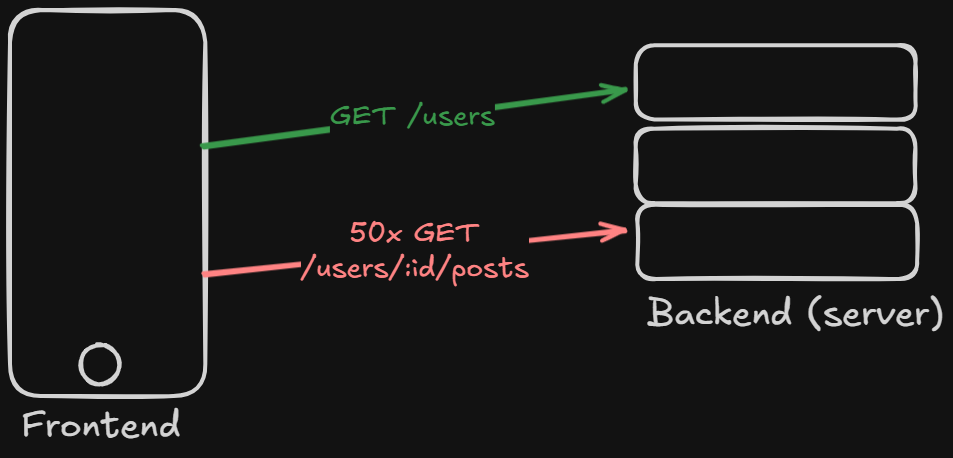
GET /users- for each user ->
GET /users/:id/posts
If you have 50 users:
- 1 request for users
- 50 requests for posts
51 round trips.
Congratulations, you reinvented dial-up.
Where it happens (twice, which is worse)
People think N+1 is just a database problem.
It's not.
It happens in two layers:
Frontend -> Backend (API level)
Multiple HTTP calls
Backend -> Database (DB level)
Multiple queries
And yes, you can have both at the same time.
A masterpiece on inefficiency.
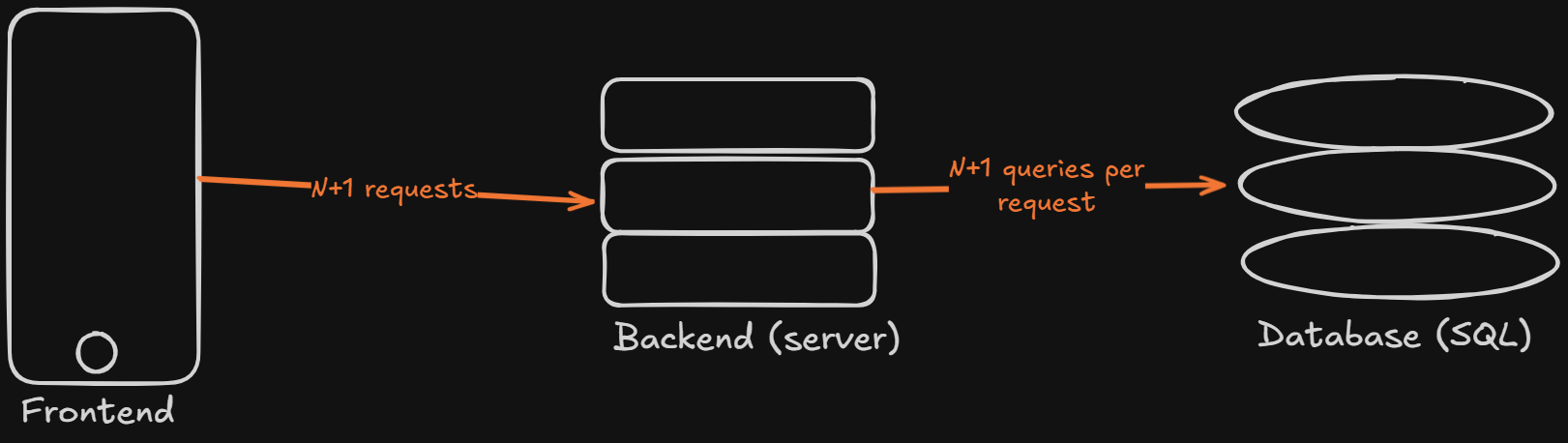
That's multiplicative pain, not additive.
The API version (Frontend suffering first)
Imagine:
GET /usersGET /users/:id/posts
Your UI needs:
User + their posts.
So you do:
const users = await getUsers()

for (const user of users) {
  const posts = await getPosts(user.id)
  user.posts = posts
}
Each request ~100ms.
50 users:
100ms × 51 ≈ 5 seconds.
The math isn't subtle.
The cost is not the CPU. It's network round trips.
Even if everything is "fast", latency stacks.
First instinct solutions
You start inventing endpoints:
GET /users-with-postsGET /posts?userIds=[]Backend for Frontend (BFF)
They work.
But...
Every new screen = new custom endpoint.
Soon your backend looks like:
/users-with-posts
/users-with-3-posts
/events-with-users
/posts-with-comments
/mobile-dashboard-v2-data
Congratulations, your build an API shaped exactly like your UI.
Maintenance becomes archaeological work.
Why GraphQL even exists
This exact pain is what pushed Facebook (now Meta) to create GraphQL.
They basically said:
"Frontend, just tell me the shape you want."
Instead of:
- many specialized endpoints
You send:
{
  users: {
    id,
    name,
    posts: {
      title,
      content
    }
  }
}
One request. Nested data.
Backend figures it out.
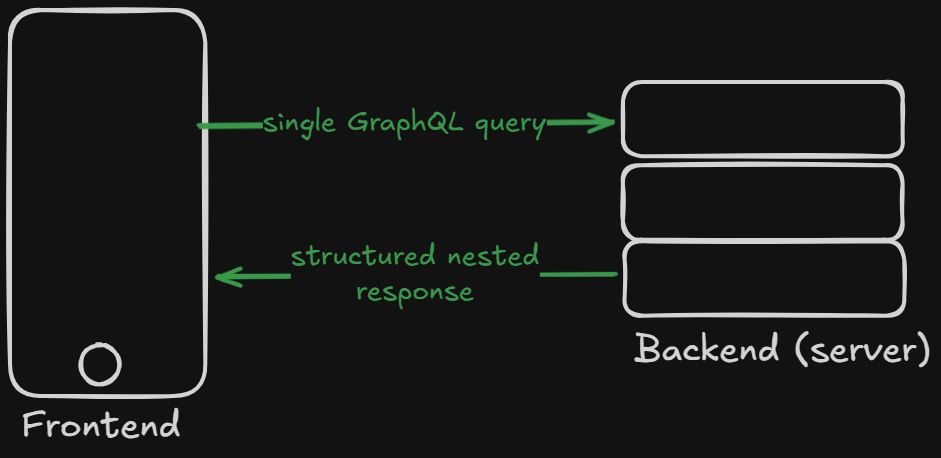
Important nuance: GraphQL solves the API N+1, not automatically the DB N+1.
You can still destroy performance inside resolvers if you're careless.
GraphQL is not magic. It's just better plumbing.
The original sin: Database N+1 (ORM edition)
This is the classic one.
And it's sneakier.
Example:
users = User.objects.all()

for user in users:
    for post in user.posts:
        ...
Looks innocent.
Under the hood:
- 1 query -> users
- N queries -> posts per user
ORM lazy loading: "Let's fetch only when needed."
Whick sounds smart.
Until it becomes 200 queries.
Lazy loading is basically: "I'll optimize later."
Later never comes.
What actually fixes it
NO fairy dust. Just being explicit.
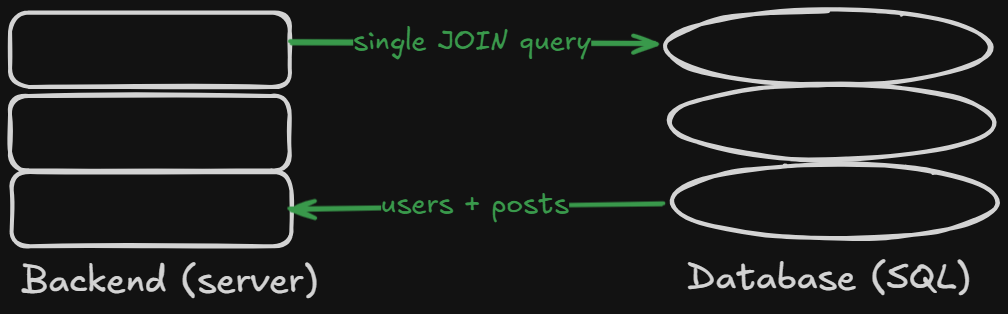
Joins / eager loading
Load everthing at once.
SQL:
SELECT * FROM users LEFT JOIN posts ON posts.user_id = users.id
ORM:
- include
- preload
- prefetch_related
- eager
Different names, same idea.
One query instead of N.
Batch by IDs
If you already have IDs:
SELECT * FROM posts WHERE user_id IN (...)
Two queries total:
- users
- posts for all users
Way better than 51.
Trade-off: you merge in memory.
Still cheaper than 50 round trips.
DataLoader / batching (GraphQL or services)
Group multiple small lookups:
Instead of:
- 50 calls Do:
- 1 batched all
Classic DataLoader pattern.
Especially useful in GraphQL resolvers.
Measure queries per request
This one is boring, so people skip it.
And then wonder why production is slow.
Add:
- query logs
- slow query logs
- APM
- "queries per request" metrics
Rule of thumb:
- 1 to 3 queries: normal
- 10+: suspicious
- 100+: you messed up
No philosophy required.
Assumptions people get wrong
Let’s challenge some common beliefs.
“It’s just one endpoint, so it’s fine” Wrong. One endpoint can execute 200 queries.
“ORM handles performance” Wrong. ORM handles convenience. You handle performance.
“GraphQL fixes it” Half wrong. It fixes API shape, not database behavior.
“Caching will save me” Only masks the problem.
If a cold request is slow, your design is slow.
Trade-offs (because nothing is free)
Fixing N+1 often means:
- more complex queries
- less “cute” ORM code
- thinking about data shape upfront
In exchange you get:
- lower latency
- fewer requests
- less infra cost
- happier frontend
- fewer “React is slow” myths
Seems like a decent deal.
Practical checklist
Before shipping an endpoint:
- how many queries does this run?
- am I loading relations inside loops?
- can I join or batch?
- can I reduce round trips?
- do I really need this many calls?
If you don’t know the answer, you probably already have an N+1.
Conclusion
N+1 is not a micro-optimization problem.
It’s architectural.
It appears:
- between frontend and backend
- between backend and database
- in REST
- in GraphQL
- in every ORM
It shows up in almost every company eventually.
Learning to spot it is basically a rite of passage for backend engineers.
Ignoring it just turns your frontend into the scapegoat.
And React didn’t do anything wrong. It just wanted some JSON.